



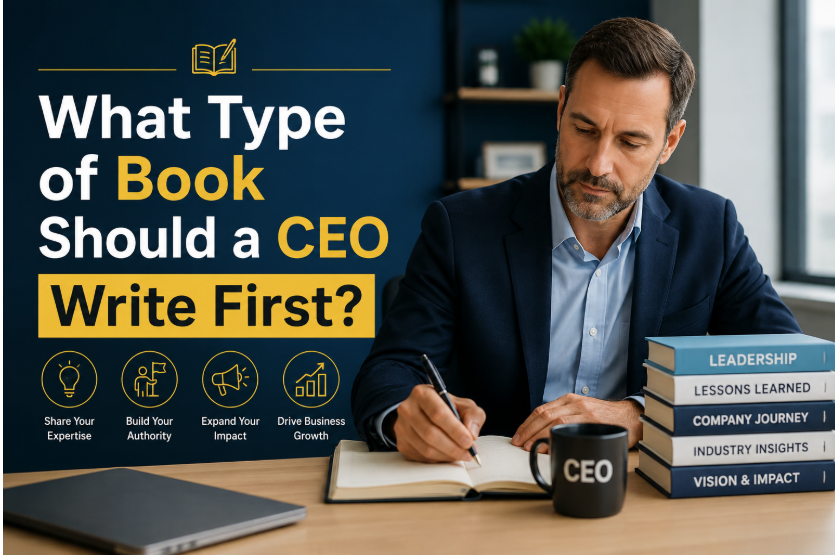
Most CEOs pick the wrong first book — and by the time a ghostwriter or editor tells them, they've already spent three months and a five-figure budget on it.
That's not a writing problem. It's a positioning problem. The question isn't "what do I want to write?" It's "What do my next 3-5 years of business goals require this book to do?" A book meant to attract acquirers reads nothing like a book meant to build a personal brand for speaking gigs, and a manuscript optimized for one rarely works for the other without a costly rewrite.
If you're a founder or executive evaluating book publishing services for the first time, this guide breaks down the five book types CEOs realistically choose from, how to match the right one to your business goal, and what the actual production process looks like once you've decided — from ghostwriting through distribution.
Executive book publishing has shifted from a vanity project to a documented business development channel. A handful of underlying trends explain why:
• LinkedIn and podcast algorithms reward authored authority. A published book gives hosts and editors a reason to book you and gives your team a reason to pitch you.
• AI Overviews and answer engines cite named experts. When your name is attached to a published, ISBN-registered book, search and AI systems have a stronger authorship signal to draw from than a blog post alone.
• Boards and acquirers do reputational diligence online. A well-positioned business book shows up before a Wikipedia stub does, and it shapes the narrative rather than leaving it to press coverage.
• Books convert into everything else. One manuscript becomes a keynote deck, a lead magnet, an onboarding document, and a year of content — the return on a single project compounds.
None of that works, though, if the book type is wrong for the goal. That's the decision to get right before any publishing services provider touches a single chapter.
Almost every executive book falls into one of five buckets. Each one serves a different business outcome, targets a different reader, and demands a different tone from your ghostwriter.
This is the most common first book for CEOs — think a proprietary methodology, a contrarian take on your industry, or a repeatable framework you've used to scale.
Best for: Founders who want to be the go-to voice for a specific business problem (e.g., "the SaaS churn guy," "the manufacturing turnaround expert").
Business outcome: Speaking invitations, media citations, inbound leads from readers who want to hire the framework's creator.
Watch-out: Frameworks age. If your methodology is still evolving, publish once it's stable enough to teach in a workshop — otherwise you'll be defending an outdated model in interviews within 18 months.
A narrative account of building the company — the near-failures, the pivots, the decision that almost sank it.
Best for: Founders with a genuinely distinctive story (not just "we worked hard and it paid off") who want to humanize the brand ahead of an IPO, acquisition, or major hiring push.
Business outcome: Emotional connection with customers, employer brand strength, press interest (memoirs get more general-media coverage than pure business books).
Watch-out: Weak memoirs read as self-congratulatory. A skilled ghostwriter will push you to include real failure, not just triumph — that's what makes it credible and quotable.
A tactical, step-by-step manual: how to hire your first ten salespeople, how to run a pricing overhaul, how to build a board.
Best for: Operators who want to be seen as implementable, not just inspirational — often used to support a course, consultancy, or fractional-executive offer on the back end.
Business outcome: Direct lead generation. Readers who finish a playbook and want done-for-them help are your highest-intent prospects.
Watch-out: Playbooks need real specificity — templates, numbers, scripts. Vague playbooks get review-bombed for being "just theory," which damages the exact authority you're trying to build.
A provocative, opinionated take arguing that an entire industry is doing something wrong — and what should replace it.
Best for: CEOs entering a category-creation phase, or challenger brands trying to reposition an entrenched market.
Business outcome: Category definition, press debate, positioning against incumbents — this is a category-design tool as much as a book.
Watch out: Manifestos require a genuinely strong point of view. If your "controversial take" is actually consensus, the book will read as flat rather than bold.
A collection of customer or client transformation stories, often light on personal narrative and heavy on proof.
Best for: B2B founders in professional services, agencies, or consulting who need social proof at scale more than personal brand.
Business outcome: Sales enablement — this book type functions almost like an extended case-study library your sales team can hand to prospects.
Watch-out: Without a strong narrative thread tying the case studies together, this reads like a brochure rather than a book. It still needs a point of view.
Rather than starting with "what do I want to say," start with the outcome and work backward.
| Business Goal | Best-Fit Book Type |
|---|---|
| Land more speaking engagements | Thought Leadership / Framework Book |
| Humanize the brand before a raise or IPO | Founder Memoir |
| Generate consulting or course leads | Playbook |
| Reposition against a legacy competitor | Industry Manifesto |
| Support a sales team with proof | Case Study Compilation |
If two goals apply equally, that's a sign you may need two books over time — not one book trying to do both jobs. A single manuscript that tries to be a memoir, a playbook, and a manifesto typically undersells all three.
Once the book type is chosen, almost every CEO works with a professional team rather than writing solo — not because they can't write, but because the opportunity cost of 200+ hours of drafting time rarely makes sense against running the company.
A competent book publisher services provider or ghostwriting agency should offer:
• Positioning and outline development before a single chapter is drafted, based on your business goal (see the framework above)
• Structured interviews — typically 8-15 recorded sessions — that become the raw material for the manuscript
• A dedicated ghostwriter who matches your voice, not a generic house style
• Developmental editing, then a separate copyedit and proofread pass (these are different skill sets and should not be the same single review)
• Cover design informed by comparable titles in your category, not a generic template
• ISBN registration and formatting for both print and ebook formats
• A distribution plan, whether that's Amazon KDP, IngramSpark for wide retail distribution, or a traditional publisher submission
Be cautious of any publishing services vendor that quotes a flat "book in a box" price without first asking about your business goal for the book. That's the single biggest predictor of a manuscript that misses its purpose.
This decision affects the timeline, control, and how the book gets used commercially.
| Factor | Traditional Publishing | Self-Publishing (Full Service) | Amazon KDP (DIY) |
|---|---|---|---|
| Timeline to print | 12-24 months | 3-6 months | 4-8 weeks |
| Editorial control | The publisher has the final say | You retain full control | You retain full control |
| Upfront cost | Low (advance possible) | Moderate to high | Low |
| Royalty rate | 10-15% typical | 100% (minus service cost) | 35-70% |
| Prestige signal | Highest for media/press | Strong if executed well | Variable, DIY perception risk |
| Best for | Category-defining manifestos with mainstream appeal | CEOs who want speed and control | Budget-constrained playbooks or supplements |
Most executives land on self-publishing through a full-service book publishing services provider — it gives them the professional quality of traditional publishing without the 18-month editorial calendar or loss of message control. Traditional publishing still makes sense when the goal is mainstream media validation (a New York Times review carries different weight than an Amazon bestseller badge), but it requires a book with genuinely broad commercial appeal, not just industry relevance.
For a CEO working with a professional team, the realistic production timeline looks like this:
Discovery and positioning (2-3 weeks) — defining the book type, target reader, and business goal using the framework above.
Outline and chapter architecture (1-2 weeks) — structuring the argument or narrative before any drafting begins.
Interviews and drafting (8-14 weeks) — the ghostwriter conducts structured interviews and produces chapter drafts for your review.
Developmental edit (3-4 weeks) — structural feedback on argument flow, pacing, and gaps, not line-level polish yet.
Copyedit and proofread (2-3 weeks) — grammar, consistency, fact-checking, and citation verification.
Cover design and interior formatting (2-3 weeks) — running in parallel with the final edit pass where possible.
ISBN registration and metadata setup — including Amazon KDP or IngramSpark listings, category selection, and keyword-optimized book descriptions.
Launch and distribution (ongoing) — press outreach, LinkedIn content extraction from the manuscript, Amazon launch sequencing, and speaking/podcast pitching.
Realistically, budget 5-8 months from kickoff to launch for a full-service self-published business book. Rushed timelines under 3 months are usually a red flag for a provider cutting corners on editing.
• Writing for peers instead of the target reader. A book meant to attract customers shouldn't read like an internal strategy memo — the jargon that signals competence to other CEOs often alienates the buyer you actually want reading it.
• Skipping the outline and going straight to drafting. This is the single largest cause of the "we're 40,000 words in, and it doesn't hang together" problem.
• Choosing a book type based on ego rather than goal. A memoir feels more personally satisfying to write than a playbook, but if the business goal is lead generation, the playbook will outperform it every time.
• Underinvesting in editing. A well-ghostwritten first draft with a rushed edit still reads as unpublished — developmental, copy, and proof passes are not optional line items.
• Treating the book as the finish line instead of the start. The highest-ROI executive books are the ones repurposed into a year of LinkedIn posts, a keynote, and sales collateral — not the ones that sit on a shelf after launch week.
Before your first call with a ghostwriter or publisher, have answers ready for:
• What specific business outcome should this book produce in the next 12 months?
• Who is the single primary reader — not "everyone in my industry," but one named persona?
• Which of the five book types above best matches that outcome?
• Traditional, full self-publishing, or Amazon KDP — and why?
• What existing material (talks, blog posts, internal memos) can shortcut the interview process?
A provider that can't help you sharpen these answers before quoting a price isn't ready to work on positioning — only production.
The type of book a CEO should write first isn't a creative decision — it's a business decision that should be made before you ever contact a book publishing services provider. Match the book type to a specific, named business outcome, choose the publishing route that fits your timeline and control needs, and only then bring in a ghostwriter or editorial team to execute.
Get the type right, and the book pays for itself many times over in speaking fees, inbound leads, and brand equity. Get it wrong, and even flawless publishing services execution won't save a manuscript built around the wrong goal.
Next step: Write down the single business outcome you want this book to produce in the next 12 months, match it against the five book types above, and bring that answer — not a half-finished draft — to your first conversation with a book publisher services provider.
Reach Out to Us for Further Assistance.
Most first-time CEO authors should start with a thought leadership or framework book if the goal is speaking and media visibility, or a playbook if the goal is direct lead generation. The right choice depends on the specific business outcome the book needs to produce, not personal preference.
A full-service self-published business book typically takes 5–8 months from initial positioning through launch, including ghostwriting, multiple editing passes, cover design, and distribution setup.
Self-publishing through a full-service provider suits most CEOs because it preserves message control and moves faster — usually 3–6 months versus 12–24 months. Traditional publishing is worth pursuing only when the book has genuinely broad commercial appeal beyond an industry audience.
Not by requirement, but most do use one because drafting a full manuscript typically requires 200+ hours that compete directly with running the business. A ghostwriter interviews the CEO and drafts in their voice, while the CEO retains full editorial approval.
Full-service packages — covering ghostwriting, editing, design, and distribution setup — commonly range from the low five figures to well into six figures depending on scope, ghostwriter experience, and whether traditional publisher submission is included. Providers quoting a flat price without a positioning conversation first are worth scrutinizing.
A memoir is narrative-driven, focused on the founder's personal journey, and used to humanize the brand or support a major company milestone like an IPO. A thought leadership book is framework-driven, focused on teaching a repeatable methodology, and is used primarily to generate speaking opportunities and inbound business leads.
Recent Posts
Use the form below to contact us regarding your ghostwriting concerns. Please be as detailed as possible. You may also email or call us for more information.