



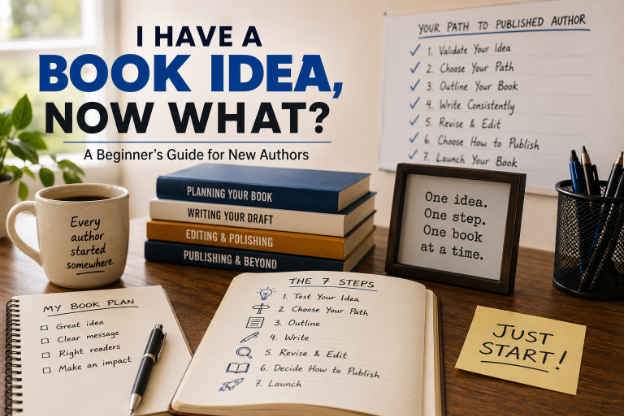
So, an idea has been living rent-free in your head, a novel, a memoir, maybe a business book that could position you as an authority in your field. You've told a friend, "I should write a book about this," and they agreed. Now comes the harder question: what do you actually do next?
The gap between "I have a book idea" and "I'm a published author" feels enormous, but it's really just a sequence of manageable steps. As someone who works closely with first-time authors at a full-service book publishing company, I can tell you the writers who finish books aren't the most talented; they're the ones who follow a process. This guide gives you that process, from validating your idea to holding your finished book in your hands.
Not every idea deserves 60,000 words. Before you invest months of your life, pressure-test the concept.
Ask yourself these questions:
• Can you summarize it in one sentence? If you can't explain the premise in 25 words or fewer, the idea isn't focused enough yet.
• Who is the reader? "Everyone" is not an audience. A memoir for adult children of immigrants or a productivity guide for freelance designers is specific enough to succeed.
• What already exists? Search Amazon's bestseller lists in your category. Comparable titles (called "comp titles" in the industry) are a good sign that they prove readers buy books like yours.
• Can you sustain it? A great blog post idea is not automatically a great book idea. Sketch 10–12 potential chapters. If you struggle to get past four, you may have an article, not a manuscript.
Quick exercise: Write your one-sentence premise, your target reader, and three comp titles on a single index card. If you can fill the card, your idea is ready for the next step.
Your genre determines your process. Here's how the workflows differ:
| Factor | Fiction | Nonfiction | Memoir |
|---|---|---|---|
| Planning tool | Plot outline or "beat sheet" | Chapter-by-chapter table of contents | Timeline of key life events |
| Typical word count | 70,000–100,000 | 40,000–70,000 | 60,000–90,000 |
| What sells it | Story and voice | Author credibility + reader problem solved | Emotional truth + universal theme |
| Write before pitching? | Yes, full manuscript | No agents accept book proposals | Usually, a full manuscript |
Nonfiction authors get a shortcut: traditional publishers often buy nonfiction based on a book proposal (an outline, sample chapters, and a marketing plan) rather than a completed manuscript. Novelists and memoirists generally need to finish the book first.
You don't need a rigid blueprint, but you do need a map. Writers without outlines are far more likely to stall at the dreaded 20,000-word mark.
• The chapter skeleton (nonfiction): List every chapter with one sentence describing its promise to the reader.
• The three-act structure (fiction): Setup (25%), confrontation (50%), resolution (25%). Note your inciting incident, midpoint, and climax.
• The snowflake method: Start with one sentence, expand to a paragraph, then to a page per chapter.
• The sticky-note wall (memoir): Write each memory or scene on a note, then arrange and rearrange until the emotional arc emerges.
First drafts die from inconsistency, not lack of talent. The math is encouraging: 500 words a day, five days a week, produces a full-length manuscript in roughly six months.
Tips that actually help first-time authors finish:
• Set a time goal (30 minutes daily) or a word goal (500 words), whichever feels less intimidating.
• Write the messy first draft without editing. Drafting and revising use different mental muscles; mixing them is how writers get stuck on chapter one for a year.
• Track your streak. A simple spreadsheet or habit app creates surprising accountability.
• Join a writing community, critique group, or accountability partner. External deadlines finish books.
Once the draft is done, resist the urge to publish immediately. Every professionally published book, traditional or independent, goes through layered editing.
Self-revision: Let the manuscript rest for 2–4 weeks, then read it fresh and fix big-picture problems yourself.
Beta readers: Recruit 3–5 readers from your target audience for honest feedback.
Developmental editing: A professional editor evaluates structure, pacing, and argument or plot.
Copyediting: Grammar, clarity, consistency, and style.
Proofreading: The final polish before formatting and printing.
Skipping professional editing is the single most common mistake new authors make and the most visible one in reader reviews.
There are three main routes to publication, each with real trade-offs:
| Publishing Route | Upfront Cost to Author | Royalties | Creative Control | Time to Publish |
|---|---|---|---|---|
| Traditional publishing | $0 (publisher pays) | 5–15% of sales | Low | 1–3 years |
| Self-publishing (DIY) | $2,000–$6,000 (editing, cover, formatting) | 35–70% | Full | 3–9 months |
| Assisted / hybrid publishing | Varies by package | Higher than traditional | High | 6–12 months |
You (or a literary agent) pitch your manuscript through query letters. The publisher covers editing, cover design, ISBN registration, and distribution. The trade-off: acceptance rates are low, timelines are long, and you give up most creative control.
Platforms like Amazon KDP and IngramSpark let you publish directly. You keep control and higher royalties, but you become the project manager, hiring the editor, cover designer, and formatter yourself.
If managing a dozen freelancers sounds overwhelming, professional book publishing services bridge the gap: you retain your rights and royalties while a team handles editing, design, ISBN setup, distribution, and launch. For busy professionals and entrepreneurs writing an authority-building book, for example, expert book publishing compresses the learning curve dramatically. Just vet providers carefully: reputable companies are transparent about pricing and never claim ownership of your rights.
Book marketing starts months before publication, not after. While you're still revising:
• Build an author platform: a simple website, an email list, and one social channel where your readers already spend time.
• Gather early reviews: Send advance reader copies (ARCs) 4–8 weeks before launch.
• Optimize your metadata: Your book description, categories, and keywords determine whether Amazon's algorithm ever shows your book to browsers.
• Plan a launch week: Coordinating email, social posts, and a temporary discount can push a new title up category rankings.
| Week | Action | Outcome |
|---|---|---|
| Week 1 | Write your one-sentence premise + identify 3 comp titles | Validated idea |
| Week 2 | Draft a chapter outline or beat sheet | A roadmap for the manuscript |
| Week 3 | Establish a daily writing routine and write your opening chapter | Momentum |
| Week 4 | Research publishing paths and set a target publication date | A concrete goal with a deadline |
Every published author you admire once sat exactly where you are: with an idea and no clear next step. The difference between them and the millions of people who "always meant to write a book" is simply that they started one outline, one writing session, one decision at a time. Your idea deserves the same chance. Fill out that index card today.
Reach Out to Us for Further Assistance.
Most first-time authors take 6–12 months to complete a draft, writing part-time. At 500 words a day, a 65,000-word manuscript takes about six months, plus 2–4 months for editing and revision.
Only for most traditional publishing deals with major houses. Self-publishing and hybrid publishing require no agent, and some small presses accept unagented submissions directly.
Budget roughly $2,000–$6,000 for professional editing, cover design, and interior formatting. Costs vary by word count, genre, and whether you hire freelancers individually or use a publishing service that bundles everything.
Ideas themselves can't be copyrighted, only the written expression of them. Your manuscript is automatically protected the moment you write it, though registering the finished work with your national copyright office adds legal enforcement power.
In self-publishing, you manage every step and hire each professional yourself. Hybrid or assisted publishing provides a coordinated team that handles editing, design, distribution, and launch for a fee while you keep your rights and the majority of royalties.
Recent Posts
Use the form below to contact us regarding your ghostwriting concerns. Please be as detailed as possible. You may also email or call us for more information.