



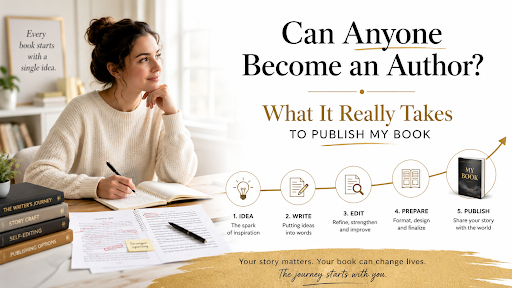
Yes — technically, anyone can call themselves an author. Amazon KDP will let you upload a manuscript today and have it live on the Kindle store by tomorrow morning
But if you've ever tried to actually publish my book: and watched it disappear into the void with zero sales, zero reviews, and zero discoverability, you already know that “publishing a book” and “becoming an author who sells books” are two very different goals.
This is the gap nobody talks about. Writing a manuscript is an emotional milestone. Publishing it professionally — with proper editing, formatting, ISBN registration, and a distribution strategy — is the technical milestone. Most first-time writers clear the first hurdle and faceplant at the second, not because they lack talent, but because they don't know what “professional” actually requires.
This guide breaks down exactly what separates a hobbyist who self-publishes once and quits from an author who builds a career — and where legitimate Book publishing services fit into that picture.
The romantic idea of “the author” — solitary genius, MFA in hand, discovered by a prestigious agent — is mostly fiction itself. In 2026, the publishing industry runs on a much more practical definition.
An author, in the modern market, is someone who has:
•Completed a manuscript to a professional editorial standard
• Made a deliberate choice between traditional, self-publishing, or hybrid paths
• Handled (or delegated) the technical requirements: formatting, ISBN, metadata, cover design
• Distributed the book through at least one legitimate retail or library channel
• A post-launch playbook: reviews, ads, and promotions
• Built some mechanism for readers to actually find the books
Notice that "innate talent" isn't on this list as a gatekeeping requirement. Talent affects the ceiling of your writing quality — it doesn't determine whether you get published. Execution does.
This matters because a huge number of aspiring writers start out believing they need permission — an agent, an MFA, a "real" publisher — before they're allowed to call themselves an author.
That belief was more accurate in 1995. It isn't anymore.
If talent isn't the primary gatekeeper, what is? Four things, consistently, across genres:
| Barrier | Why It Stops Writers | How to Solve It |
|---|---|---|
| Manuscript quality | Self-edited drafts read like self-edited drafts | Hire a developmental editor + line editor before formatting |
| Publishing knowledge gap | ISBNs, metadata, KDP categories, and distribution rights confuse first-timers | Use professional book publishing services or a publishing consultant |
| Time and consistency | Most manuscripts die in the "80% done" stage | Set a fixed word-count cadence, not a vague deadline |
| Post-launch marketing | Publishing ≠ selling; most books get zero visibility after launch | Build an author platform and pre-launch list before publication day |
The pattern here is important: three of the four barriers aren't creative problems. They're operational problems. This is exactly why the publishing services industry exists — not to replace your voice as a writer, but to handle the parts of the process that have nothing to do with writing talent.
Every aspiring author eventually has to choose a publishing model. There's no universally “better” option — the right path depends on your goals, timeline, and how much control you want over the process.
| Factor | Traditional Publishing | Self-Publishing (KDP, IngramSpark) |
|---|---|---|
| Upfront cost | $0 (advance paid to author) | You fund editing, cover, formatting |
| Timeline to market | 12–24 months | 4–12 weeks |
| Royalties | 10–15% typically | 35–70% depending on platform/price |
| Creative control | Limited — publisher decides cover, title, edits | Full control |
| Distribution reach | Bookstores, libraries, international rights | Primarily online retail unless pushed wider |
| Gatekeeping | Agent + publisher must accept the manuscript | None |
| Best for | Career novelists, major nonfiction platforms | First-time authors, niche nonfiction, series fiction |
Hybrid / assisted publishing sits between these two: shared creative control, a paid intake process instead of agent gatekeeping, and often print + online distribution. It's the right fit for authors who want professional-grade support without querying dozens of agents — but it's also the space with the highest concentration of vanity press operators disguised as “publishing services,” so vetting matters more here than anywhere else.
No publishing strategy fixes a manuscript that isn't ready. Budget for at least two editorial passes: a developmental edit (structure, pacing, plot/argument) and a line/copy edit (grammar, clarity, consistency). Self-editing alone is the single most common reason self-published books underperform.
Decide traditional vs. self-publishing vs. hybrid based on the comparison table above. This decision affects your timeline, budget, and how much creative control you retain.
This covers editing, cover design, interior formatting, and metadata optimization. A book's cover and interior formatting are judged by the same standards as traditionally published books — readers don't grade self-published work on a curve.
An ISBN identifies your book in retail and library systems. In the US, ISBNs are issued through Bowker; in most other countries, a national ISBN agency handles this. Amazon KDP will assign a free ASIN if you don't want to buy your own ISBN, but owning your ISBN gives you more control over how your book is listed and who's recorded as the publisher of record.
KDP remains the dominant self-publishing platform for ebooks and print-on-demand. For wider print distribution into bookstores and libraries, platforms like IngramSpark extend reach beyond Amazon's ecosystem.
A launch is a moment; discoverability is ongoing. Author websites, email lists, and category/keyword optimization on retail platforms all matter more most first-time authors expect.
Not every author needs to outsource every step. Here's a realistic breakdown of where DIY works and where professional support pays for itself.
| Task | DIY Viable? | Recommend Professional Help? |
|---|---|---|
| Manuscript writing | Yes | Only if using ghostwriting services |
| Developmental editing | Rarely — hard to self-assess structure | Yes, almost always |
| Copyediting/proofreading | No | Yes — typos damage credibility permanently |
| Cover design | Not recommended for genre fiction | Yes — genre covers follow category conventions |
| Interior formatting | Possible for simple ebooks | Yes for print books or complex layouts |
| ISBN registration | Yes, straightforward | Optional — some services bundle this |
| Marketing strategy | Partially | Yes for paid ads, PR, and launch campaigns |
Legitimate book publishing services are transparent about costs, give you full rights to your work, and don't promise bestseller status. If a “publishing company” charges thousands of dollars, promises guaranteed sales, and is vague about what rights you retain, that's a vanity press red flag — not a publisher.
Not everyone who wants to publish my book is a trained writer — and that's fine. Executives, entrepreneurs, coaches, and memoirists frequently use ghostwriting services to turn their expertise or life story into a professionally written manuscript. This isn't cheating the system; it's an established, widely used model in nonfiction publishing.
A reputable ghostwriting arrangement includes:
If your value is your expertise or story rather than your prose style, ghostwriting is a legitimate route to becoming a published author — not a shortcut that disqualifies you from the title.
Myth: You need an English degree. False. Genre knowledge, editing, and revision discipline matter far more than formal credentials.
Myth: Self-published books aren't "real" books. False. Self-published titles regularly outsell traditionally published books, and platforms like KDP and IngramSpark distribute to the same retail and library networks.
Myth: You need a literary agent to publish. Only true for traditional publishing. Self-publishing and hybrid models bypass agents entirely.
Myth: Publishing is a one-time event. False. Discoverability is an ongoing process — categories, keywords, reviews, and marketing determine whether readers find your book after launch, not just on day one.
Yes — with a caveat. Anyone can publish a book. Becoming an author in the professional sense — someone whose books are edited to market standard, properly distributed, and positioned to actually reach readers — requires treating publishing as a project with real steps, not a single upload button.
If you're ready to publish my book the right way, the sequence is consistent regardless of genre: finish and edit the manuscript, choose your publishing path deliberately, use professional book publishing services where your own skill set has gaps, and build discoverability before launch day, not after.
No. You retain full copyright and can update, reprice, or unpublish your book at any time.
Recent Posts
Learn how book publishing services help you price your KDP ebook right to qualify for the 70% royalty tier instead of settling for the lower 35% rate.
Learn how to publish your book on Amazon with this step-by-step KDP guide and discover why professional book publishing services help authors publish with confidence.
Use the form below to contact us regarding your ghostwriting concerns. Please be as detailed as possible. You may also email or call us for more information.