



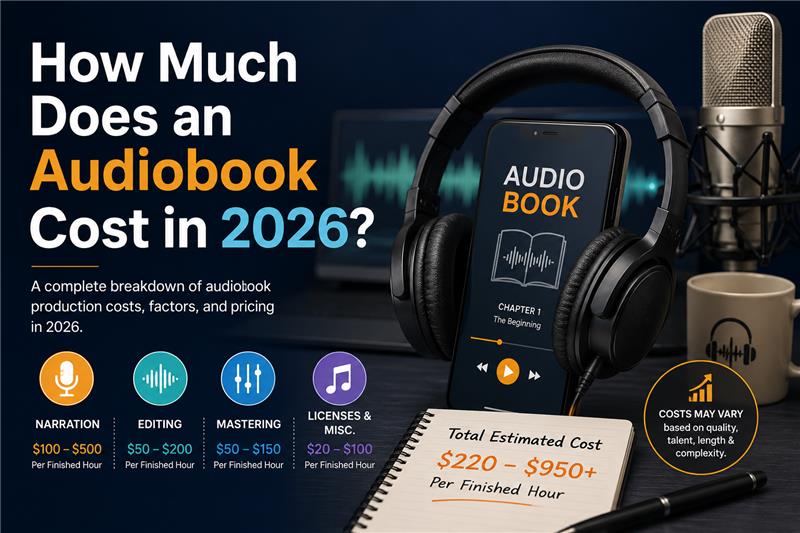
Quick answer: A professionally produced audiobook costs $200–$500 per finished hour (PFH). For a standard 10-hour novel, that’s $2,000–$5,000 for narration, editing, proofing, and mastering. A full-service audiobook production package that includes project management, distribution setup, and a higher-tier narrator runs $6,000–$8,000. AI-narrated audiobooks cost a fraction of that — often $20–$150 total — but come with retailer restrictions and quality trade-offs covered below.
That range is wide because “audiobook cost” isn’t one number. It’s the sum of four separate decisions: who narrates it, how it’s edited, how it’s distributed, and how much control you want over the process. Below is the actual breakdown, not a rounded-off estimate.
Audiobook production doesn’t use a flat per-project fee the way, say, cover design does. The industry standard is PFH — per finished hour — which means you’re billed on the length of the final, edited audio file, not on how long it took to create.
This matters because it decouples price from your manuscript’s word count in a way most authors don’t expect until they get a quote. As a rough conversion:
• 1 finished hour ≈ 9,000–9,400 words of manuscript
• A 60,000-word novel finishes around 6.5 hours
• A 90,000-word novel finishes around 9.5–10 hours
• A 120,000-word epic fantasy finishes around 13 hours
The PFH model exists because narration, editing, and mastering all scale with runtime — not with how “hard” the book was to read. A narrator producing a 10-hour audiobook typically spends 25–30 total hours on it once you add reading-through, recording retakes, editing, and QC. That ratio is why PFH rates look high in isolation but usually reflect a fair hourly wage once you do the math.
| Book Length | DIY (self-recorded) | Indie / ACX Narrator | Professional Studio | Full-Service Package |
|---|---|---|---|---|
| 6 hours (≈55K words) | $50–$500 (equipment only) | $900–$1,500 | $1,500–$2,400 | $3,600–$4,800 |
| 8 hours (≈75K words) | $50–$500 | $1,200–$2,000 | $2,000–$3,200 | $4,800–$6,400 |
| 10 hours (≈90K words) | $50–$500 | $1,500–$2,500 | $2,500–$4,000 | $6,000–$8,000 |
| 15 hours (≈140K words) | $50–$500 | $2,250–$3,750 | $3,750–$6,000 | $9,000–$12,000 |
| 20 hours (≈185K words) | $50–$500 | $3,000–$5,000 | $5,000–$8,000 | $12,000–$16,000 |
The DIY column stays flat because it’s largely a one-time equipment cost (USB or XLR microphone, audio interface, treated recording space, editing software), not a per-hour narrator fee. What it doesn’t capture is your own time — realistically 3–5 hours of editing per finished hour if you’re doing your own post-production, which is the single most underestimated line item in DIY audiobook budgets.
A PFH quote isn’t just “voice acting.” It bundles several distinct production stages, and knowing what’s included (and what isn’t) is how you avoid a surprise invoice.
The performance itself — pacing, character differentiation, tone, breath control, pronunciation research. This is the largest single cost driver and the one place quality differences are most audible to listeners.
Removing mouth clicks, breaths, page turns, and flubbed lines; assembling the cleanest take of each sentence. This is the stage most narrators underquote when they’re new, because it routinely takes longer than the recording itself.
A second listener compares the finished audio against the manuscript, line by line, to catch skipped words, mispronunciations, or continuity errors. Skipping this step is the most common reason self-produced audiobooks get rejected by platforms like Audible.
Leveling volume, removing background noise, and hitting the technical loudness specs (RMS, peak levels, noise floor) that Audible, Apple Books, and other retailers require for acceptance. A file can sound “fine” to your ear and still fail ACX’s technical requirements.
• Audiobook cover art is usually priced separately. Authors can work with a professional book cover design service to create a square, retailer-ready version that remains readable at thumbnail size.
• Distribution/aggregator fees if you’re not going direct through ACX
• Pickup sessions for post-publication corrections
• Music or sound design for bonus content (intros, outros, bonus chapters)
Ask any vendor to itemize these before you sign. A quote that looks 20% cheaper than a competitor’s is sometimes just missing a line item, not actually less expensive.
| Tier | PFH Rate | Typical Background | Best Fit |
|---|---|---|---|
| Beginner | $50–$150 | Building a portfolio, 1–2 recording hours per finished hour | Low-stakes projects, tight budgets, willing to accept some inconsistency |
| Mid-level | $150–$300 | Genre specialization, 2–3 years active, agency-repped | Most self-published fiction and nonfiction |
| Top-tier / union | $300–$500+ | Award-nominated, SAG-AFTRA, publisher-vetted | Lead titles, series with marketing budget behind them, hybrid/traditional deals |
A useful gut-check: a narrator’s PFH rate divided by 2.5–3 (the average recording-to-finished-hour ratio for experienced talent) roughly approximates their effective hourly wage. A $200 PFH narrator is making somewhere around $65–$80/hour once you account for research, recording, retakes, and revisions — which is why rates below $50 PFH usually correlate with narrators still building their retake speed and ear for pacing.
| Factor | DIY Self-Recording | AI/TTS Narration | Hired Human Narrator | Full-Service Studio |
|---|---|---|---|---|
| Upfront cost | $50–$500 (equipment) | $20–$150 per book | $900–$5,000 | $3,600–$16,000+ |
| Your time investment | Very high (30–50 hrs for a 10-hr book) | Low | Low | Minimal |
| Retailer acceptance | Yes, if it passes QC | Restricted on some platforms — check current policy before committing | Yes | Yes |
| Character/emotional range | Depends entirely on your skill | Improving fast, still audibly synthetic on longer emotional arcs | High | Highest |
| Revisions after manuscript edits | Free (your time) | Near-instant, cheap | Often billed as a pickup session | Billed as a pickup session |
| Best for | Nonfiction with a strong personal voice, memoir | Draft narration, accessibility copies, backlist titles with thin margins | Most fiction and narrative nonfiction | Lead titles, hybrid deals, franchise series |
The information most cost articles leave out: AI narration’s per-book price advantage is real, but it doesn’t fully transfer to your bottom line unless the retailer accepts it without restriction and listeners don’t bounce off it in reviews. Audiobook return rates on major platforms are influenced heavily by the first 15 minutes of listening — a synthetic-sounding narrator increases early returns in a way that a $150 PFH human narrator usually doesn’t, even though the AI option looks like a 90% cost saving on paper. Run the AI option as a pilot on a low-risk backlist title before committing your lead title to it.
Every generic cost article stops at narration + editing + mastering. Here’s what actually moves the final invoice in practice:
Pickup sessions. If you catch an error after “final” delivery, or your manuscript changes post-recording (common with trad-published titles that get late edits), re-recording costs studio time on top of the original quote — often billed at a reduced PFH rate but rarely free.
Dual or multi-cast narration. Splitting a book between two narrators (common in dual-POV romance) roughly doubles recording and editing time for the overlapping sections, even though runtime doesn’t double. Budget for a 60–80% cost increase over single narration, not 100%, since editing/mastering can be partially shared.
Rush fees. Standard turnaround is 3–4 weeks after final manuscript delivery. Compressing that timeline routinely adds 15–30% to the quote, because it forces the narrator to skip other bookings.
Exclusivity terms. ACX’s exclusive distribution (Audible-only) pays a higher royalty share than the non-exclusive option, but locks your audiobook out of Apple Books, Kobo, Spotify, and library platforms like OverDrive/Libby for the contract term. Authors frequently treat this as a distribution decision when it’s really a pricing decision — non-exclusive access to a wider retail footprint can outperform the higher single-platform royalty over the life of the title.
Royalty-share contracts. A narrator willing to work for reduced or zero upfront pay in exchange for a royalty split (typically 50/50 through ACX) lowers your cash cost to near zero — but transfers long-term revenue to the narrator indefinitely, often with no buyout clause. This is a real cost, just a deferred one, and it should be modeled against projected lifetime sales, not treated as “free.”
Cover art. Audiobook covers use a 1:1 square ratio and need to be legible at a 100x100px thumbnail — a repurposed ebook cover often fails this test. Budget $50–$300 separately if your existing cover designer doesn’t already offer an audiobook variant.
• 1. Get your finished-hour estimate: manuscript word count ÷ 9,300 ≈ finished hours.
• 2. Pick a narrator tier based on genre stakes and marketing budget (beginner / mid / top-tier from the table above).
• 3. Multiply finished hours × PFH rate = core narration + editing + mastering cost.
• 4. Add 10–15% as a buffer for pickups, proofing corrections, and cover art.
• 5. Decide exclusivity before you sign — it affects both your cost structure and your long-term distribution reach, not just your royalty percentage.
Example: a 95,000-word novel (≈10.2 finished hours) with a mid-tier $200 PFH narrator = $2,040 core cost, $2,244–$2,346 with buffer.
• Quoting narration only, then being blindsided by proofing/mastering as “extras.” Ask for an all-in PFH figure up front.
• Assuming a cheaper narrator saves money overall. A $75 PFH narrator who needs three pickup rounds can cost more in elapsed time and revision fees than a $180 PFH narrator who nails it in one pass.
• Treating exclusivity as a royalty decision only. It’s a distribution decision with a multi-year tail.
• Skipping the QC/proofing pass to save money. This is the single most common reason retailers reject submitted files, which costs more in re-submission delays than the proofing pass would have cost upfront.
• Not budgeting for cover art as a separate line item.
• Audiobook pricing runs on per finished hour (PFH), not word count — budget from your projected finished-hour length, not your manuscript’s word count alone.
• $200–$500 PFH covers narration, editing, proofing, and mastering for professional-quality production.
• The real cost differentiator between vendors isn’t the PFH number — it’s what’s bundled into it. Get an itemized quote.
• Exclusivity and royalty-share decisions are long-term financial decisions, not fine print.
• AI narration is a legitimate cost-reduction tool for the right title, not a universal replacement for human narration.
If you’re weighing narrator quotes against a full-service package or trying to decide whether exclusivity makes sense for your title, it helps to run the numbers against your specific manuscript rather than a generic industry average — a publishing specialist can review your manuscript length, genre, and sales goals and map out which production route actually pencils out for your book.
Typically $2,500–$4,000 through an indie or professional narrator, or $6,000–$8,000 for a full-service package that includes project management and distribution setup.
Upfront, yes — equipment runs $50–$500. But DIY editing takes 3–5 hours per finished hour, and self-recorded audio has a materially higher rejection rate on Audible/ACX’s technical QC checks unless you already have editing experience.
Beginner narrators charge roughly $50–$150 per finished hour; mid-level, experienced narrators charge $150–$300; top-tier and union narrators charge $300–$500 or more.
It cuts upfront cost dramatically ($20–$150 per book) and is worth piloting on backlist or accessibility-focused titles. For a lead title, weigh the cost saving against retailer restrictions and the effect a synthetic-sounding narrator can have on early listener returns.
Exclusive pays a higher royalty share but restricts distribution to Audible/Amazon only. Non-exclusive pays less per sale but lets you distribute through Apple Books, Kobo, Spotify, and library platforms simultaneously.
Use the form below to contact us regarding your ghostwriting concerns. Please be as detailed as possible. You may also email or call us for more information.