



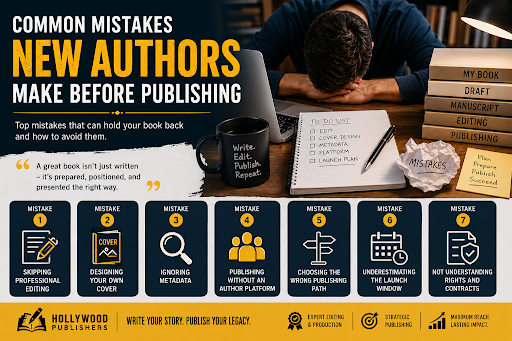
Most first-time authors do not fail because they lack talent. They fail because nobody told them what happens between finishing a manuscript and holding a published book. The gap between those two moments is where careers get derailed quietly, expensively, and almost always unnecessarily.
At Hollywood Books Publisher, we have worked with enough debut authors to recognize the patterns. The same mistakes appear with remarkable consistency, regardless of genre, background, or how good the writing actually is. Partnering with a full-service book publishing company early changes almost everything. Here is what actually goes wrong and why it keeps happening.
This is the most common and most costly mistake new authors make. A first draft is raw material, not a finished product. The writing may be strong. The ideas may be compelling. But a manuscript that has not been through professional editing is not ready for readers, regardless of how many times the author reads it themselves.
Self-editing is not the problem. Proximity is. You cannot see what is missing in your own writing because your brain fills in the gaps automatically. You know what you meant to say, which makes it nearly impossible to notice where the reader gets lost.
What professional editing actually covers:
• Developmental editing — addresses structure, argument flow, and whether the book delivers on its premise
• Line editing — refines sentence-level clarity, rhythm, and voice consistency
• Copyediting — catches grammar, punctuation, and factual inconsistencies
• Proofreading — catches everything that survived the earlier rounds
Skipping any stage is a gamble. Skipping all of them is the fastest way to publish something you regret.
Authors are not graphic designers. This is a professional reality, not a criticism. Book cover design sits at the intersection of marketing psychology, genre convention, and visual communication. Getting it wrong does not just look unprofessional; it actively suppresses sales.
Readers make purchasing decisions in seconds. A cover that fails to signal the right genre and quality level loses the reader before a single word is read. This applies to physical bookstores and online retail — more so online, where your cover competes against hundreds of thumbnails at once.
What a professionally designed cover communicates:
• Genre positioning — the reader instantly knows the category
• Quality signal — production value on the cover implies production value inside
• Author credibility — a polished cover signals a serious author, not a hobbyist
Professional cover design is one of the highest-ROI investments a new author makes — and one of the most frequently skipped.
Metadata is the information attached to your book in publishing databases: title, subtitle, keywords, categories, and description. Most new authors treat this as an afterthought. It is a significant strategic error.
Metadata is how readers find your book. On Amazon, on Google, in library catalogs, it determines whether your book surfaces in relevant searches or disappears entirely. A book with poorly optimized metadata can have exceptional content and still sell almost nothing.
Critical metadata elements authors consistently underestimate:
• Subtitle — carries keyword weight and sets reader expectation
• BISAC categories — industry classification that places your book in the right retail sections
• Keywords — seven Amazon slots that determine search visibility
• Book description — functions as sales copy, not a summary
Getting metadata right requires understanding how readers search and how algorithms surface books in your category.
A book without an audience is a tree falling in an empty forest. Publishing is not a marketing strategy; it is a product launch. Like any product launch, it requires an existing audience.
New authors treat publication as the beginning of their visibility effort. It is not. By the time your book publishes, you should already have an email list expecting it, a social presence building anticipation, media relationships ready for coverage, and advance copies distributed to reviewers.
Building a platform after publication is like opening a restaurant and then telling people you exist. The launch window is narrow; arriving without an assembled audience means missing the period when algorithms, media, and word-of-mouth work in your favor simultaneously.
The publishing landscape in 2026 offers more options than ever. Traditional publishing, self-publishing, and hybrid publishing all represent viable paths depending on goals, timeline, and resources. New authors frequently choose the wrong one by default.
Traditional publishing offers credibility and distribution but requires years of querying and significant rights concessions. Self-publishing offers speed and control but places every production and marketing responsibility on the author. Hybrid publishing through a book publishing agency combines professional production with author ownership and faster timelines.
The right path depends entirely on what you want the book to accomplish. A reputable book publishing services provider will tell you which model fits your goals, not push you toward the most profitable option for them.
The launch window — the first four to eight weeks after publication — is the highest-leverage period in a book's commercial life. Algorithms reward early sales velocity. Media interest peaks at publication. Word-of-mouth spreads fastest when a book is new.
New authors consistently arrive at launch without the infrastructure to capitalize on it:
• No pre-orders to concentrate early sales signals
• No launch team coordinating simultaneous reviews
• No media pitches sent far enough in advance
• No email campaign converting existing audience into buyers
The launch window cannot be recreated. A slow start creates a trajectory that is extremely difficult to reverse.
Publishing contracts determine who controls your work, for how long, and under what commercial terms. New authors frequently sign agreements without understanding what they are giving away.
Rights decisions authors make without adequate understanding:
• Territory rights — which countries the publisher controls
• Subsidiary rights — film, translation, audio, and adaptation
• Reversion clauses — conditions under which rights return to you
• Royalty structures — how earnings are calculated across formats
When you hire a book publisher, you enter a commercial relationship with long-term implications. Understanding the contract before signing is non-negotiable.
| Decision | Prepared Author | Unprepared Author |
|---|---|---|
| Professional editing | Strong reader retention | Poor reviews and high returns |
| Cover design | Discoverable and genre-appropriate | Invisible in retail |
| Metadata optimization | Surfaces in search | Buried in catalog |
| Platform before launch | Strong velocity | Slow start that compounds |
| Rights reviewed | Full ownership clarity | Long-term disputes |
Every row represents a decision made before the book is published. Every decision compounds in either direction. Hollywood Publishers works with debut and experienced authors alike to make sure the path from manuscript to market is built on decisions that hold up over time.
Hollywood Books Publisher works with first-time and experienced authors to navigate every stage of the publishing journey from manuscript to market, with the editorial standards and strategic clarity your book deserves.
If you are asking this question, you almost certainly need developmental editing first. Proofreading catches surface errors in a structurally sound manuscript. Developmental editing addresses whether the book works as a whole. Most first manuscripts need developmental work before line editing or proofreading become relevant.
Absolutely, but legitimacy depends entirely on production quality. A self-published book with professional editing, design, and launch strategy is commercially indistinguishable from a traditionally published one. Skip those steps and the difference becomes immediately apparent to readers and retailers alike.
Twelve months before publication is the minimum. Eighteen to twenty-four months gives you enough runway to build an email list, establish content presence, and develop media relationships that make a launch actually perform.
Look for demonstrated editorial process, not just production services. Ask to see books they have published and speak with authors they have worked with. Understand the rights structure before signing. A reputable book publishing agency is transparent about what you own when the project ends.
In limited cases, yes, but relaunches are significantly harder than launching the first time correctly. Early sales velocity, coordinated reviews, and algorithmic momentum are difficult to recreate once the initial window closes. Invest in the launch before it happens, not in recovering from one that did not.
Use the form below to contact us regarding your ghostwriting concerns. Please be as detailed as possible. You may also email or call us for more information.