



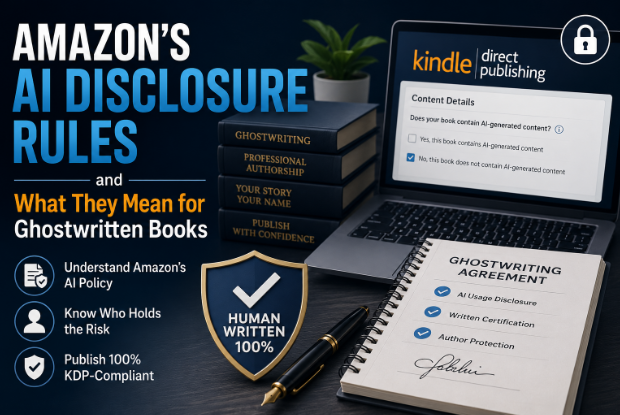
If you've hired a ghostwriter or you're about to, one question is probably keeping you up at night: Does Amazon's AI disclosure policy apply to my ghostwritten book?
The short answer: a genuinely human-written ghostwritten book does not require AI disclosure on Amazon KDP. But the long answer is where things get interesting, because the policy has quietly reshaped how authors must vet ghostwriting services, structure contracts, and protect their KDP accounts.
At Hollywood Publishers, we've watched authors get blindsided not by the rules themselves, but by ghostwriters who secretly used AI and left their clients holding the compliance risk. This guide breaks down exactly what the rules say, who carries the liability, and what almost no other resource tells you: how to audit your ghostwriter before you publish.
When Amazon rolled out its AI content policy for Kindle Direct Publishing (KDP), it drew one critical line in the sand. Publishers must inform Amazon when a book contains AI-generated content, such as text, images, or translations created by an AI tool during the publishing or republishing workflow. AI-assisted content, by contrast, does not require disclosure.
Here's how Amazon defines the two categories:
| Category | Definition | Disclosure Required? |
|---|---|---|
| AI-generated | An AI tool created the actual text, images, or translations, even if a human edited them afterward. | Yes |
| AI-assisted | A human created the content; AI only helped with brainstorming, outlining, grammar checks, or refinement. | No |
| Fully human-written | A person (author or ghostwriter) wrote every word from scratch. | No |
The disclosure itself is internal. It appears in your KDP dashboard during book setup as a checkbox on the Content Details page, and it is not displayed on your product page. Amazon has stated the disclosure doesn't affect royalties or search rankings.
Amazon's test isn't whether AI touched your workflow; it's who produced the words on the page. If a person wrote the manuscript and used AI to polish grammar, that's AI-assisted. If an AI tool drafted chapters and a person edited them, that's AI-generated and must be disclosed, even after substantial editing.
Here's the part that confuses thousands of authors: ghostwriting and AI disclosure are two completely separate issues.
Amazon has never required authors to disclose that a book was ghostwritten. Ghostwriting is a legitimate, centuries-old publishing practice from presidential memoirs to celebrity autobiographies. When you hire a professional ghostwriting team, the copyright and authorship credit belong to you under a standard work-for-hire agreement. Nothing in Amazon's content guidelines changes that.
What Amazon cares about is how the words were produced. That creates three possible scenarios for your ghostwritten book:
Scenario 1 — Human ghostwriter, no AI generation. Your ghostwriter conducted interviews, researched, and wrote every chapter themselves (perhaps using AI for grammar checks only). No disclosure required.
Scenario 2 — Ghostwriter used AI to generate drafts. The ghostwriter prompted ChatGPT or a similar tool to produce chapter text, then edited it. Disclosure required, and here's the catch: you, the publishing account holder, are the one who must check that box.
Scenario 3 — You don't actually know. This is the most dangerous position. If your ghostwriter used AI without telling you and you publish without disclosure, your account carries the violation, not theirs.
This is the piece most articles on this topic skip entirely: Amazon holds the KDP account holder responsible, not the ghostwriter.
When you publish through KDP, you certify the accuracy of your content declarations. If Amazon's detection systems, which combine automated writing-pattern analysis with human review, flag your book as undisclosed AI-generated content, the consequences fall on you:
● Book removal from sale, often without prior warning
● KDP account suspension or termination for repeat violations
● Withheld royalties on removed titles
● Restrictions on republishing flagged titles
Your ghostwriter faces none of this. Their name isn't on the account. This liability gap is exactly why choosing the right ghostwriting firm has become a compliance decision, not just a creative one.
Amazon has significantly ramped up enforcement, using automated detection that analyzes writing patterns, metadata, and submission velocity alongside human reviewers. Amazon has also retroactively reviewed previously published titles, asking publishers to update the disclosure status on older books. "Nobody will notice" is no longer a strategy.
Before Amazon's policy, vetting ghostwriting services meant checking portfolios and testimonials. Today, it means auditing their production process. Here's the due diligence framework we recommend:
Email your prospective agency: "Do your writers use AI tools to generate manuscript text, and will you certify the AI status of my manuscript in writing?" A professional ghostwriting company will answer without hesitation. Evasive answers ("we use industry-standard tools") are a red flag.
Your ghostwriting agreement should include:
● A representation clause stating whether AI was used to generate any portion of the text.
● A notification obligation requiring the writer to inform you if AI generation occurs at any stage.
● An indemnification clause covering losses if an undisclosed AI violation results from the writer's misrepresentation.
Legitimate human ghostwriting leaves a paper trail: interview recordings, chapter outlines, draft revisions with tracked changes, and back-and-forth feedback rounds. AI-generated manuscripts tend to arrive suspiciously fast and suspiciously complete. Ask to see the process, not just the product.
Before Amazon's policy, vetting ghostwriting services meant checking portfolios and testimonials. Today, it means auditing their production process. Here's the due diligence framework we recommend:
Email your prospective agency: "Do your writers use AI tools to generate manuscript text, and will you certify the AI status of my manuscript in writing?" A professional ghostwriting company will answer without hesitation. Evasive answers ("we use industry-standard tools") are a red flag.
Your ghostwriting agreement should include:
● A representation clause stating whether AI was used to generate any portion of the text.
● A notification obligation requiring the writer to inform you if AI generation occurs at any stage.
● An indemnification clause covering losses if an undisclosed AI violation results from the writer's misrepresentation.
Legitimate human ghostwriting leaves a paper trail: interview recordings, chapter outlines, draft revisions with tracked changes, and back-and-forth feedback rounds. AI-generated manuscripts tend to arrive suspiciously fast and suspiciously complete. Ask to see the process, not just the product.
Document your ghostwriter's certification, your contract, and your correspondence. If Amazon ever questions your disclosure status, records of your workflow and your writer's written assurances are your best defense.
Compliance is the floor, not the ceiling. Even correctly disclosed AI-generated books face headwinds: Amazon's quality guidelines apply to every title, and low-quality, repetitive, or unedited content gets flagged or review-bombed regardless of disclosure status.
A professional human ghostwriter delivers what AI structurally cannot:
● Your authentic voice, captured through interviews and revision—not a statistical average of internet prose.
● Original stories and lived expertise that build genuine reader trust and support your authority (the heart of E-E-A-T for authors building a brand).
● Fact-checked, accountable nonfiction critical in health, finance, and business niches where AI hallucinations can genuinely harm readers.
● A manuscript you can defend to Amazon, to your audience, and to your own conscience.
For thought leaders, executives, and experts publishing to build credibility, an undisclosed (or even disclosed) AI-generated book can undermine the very authority the book was meant to establish.
Amazon's AI disclosure rules didn't make ghostwriting harder; they made transparency non-negotiable. A book written by a professional human ghostwriter needs no AI disclosure, carries no compliance risk, and positions you exactly where you want to be: as a credible author with a manuscript that can withstand scrutiny.
The real risk isn't the policy. It's not knowing how your book was made.
Publish with confidence and full compliance. At Hollywood Publishers, every manuscript is written by professional human ghostwriters, backed by written AI-free certification and a transparent, interview-driven process. Whether you need memoir, business, or fiction ghostwriting solutions, our team delivers a book that's authentically yours and 100% KDP-compliant. Book your free consultation with Hollywood Publishers today.
Reach Out to Us for Further Assistance.
No. Amazon has no policy requiring disclosure of ghostwriting. Under a work-for-hire agreement, you own the copyright and are legally the author. Amazon's disclosure rules apply only to AI-generated content, such as text, images, or translations produced by AI tools.
You're still responsible. Amazon holds the KDP account holder accountable for accurate content declarations. If you discover AI generation after publishing, update your book's disclosure status in the KDP dashboard immediately. Under-disclosing carries penalties; correcting your disclosure does not. Then review your contract with the writer.
No. Grammar checking, brainstorming, outlining help, and editing suggestions fall under AI-assisted content, which Amazon explicitly exempts from disclosure as long as a human wrote the actual manuscript text.
Amazon states the disclosure is internal, isn't shown to customers, and doesn't affect royalties or rankings. However, AI-generated books face heightened quality review, and undisclosed AI content risks removal or account suspension, a far bigger threat to sales than the disclosure itself.
Ask for a written AI-use certification, include an AI warranty and indemnification clause in your contract, request evidence of a human writing process (interviews, drafts, revisions), and keep records. A reputable ghostwriting company should provide this documentation as standard practice.
Recent Posts
Use the form below to contact us regarding your ghostwriting concerns. Please be as detailed as possible. You may also email or call us for more information.