



You just finished your manuscript. Months maybe years of work. And now someone is telling you to pay to publish it. They're enthusiastic. They're professional-sounding. Their website looks polished.
And that's exactly when authors get robbed.
Fraudulent publishers have one enormous advantage over you: they've done this hundreds of times. You've done it once. They know what an excited author looks like, what they hear, and precisely which buttons to push to get a signature before the doubt sets in.
The book publishing services industry is largely unregulated. Anyone can call themselves a publisher. Anyone can build a website, write glowing fake testimonials, and vanish with your deposit six weeks later.
This blog exists to make sure that doesn't happen to you.
The Alliance of Independent Authors and the Writer Beware database document hundreds of predatory publishing incidents every single year. And those are just the ones reported.
Most authors who get scammed don't go public; they're embarrassed. They absorb the loss quietly and either give up on publishing entirely or start over, poorer and more cynical.
The tactics used by fraudulent publishers are not obvious. They don't show up wearing villain costumes. They show up sounding like exactly what you've been looking for.
Here's how to see through them.
Let's start with the one sign that should immediately put you on guard.
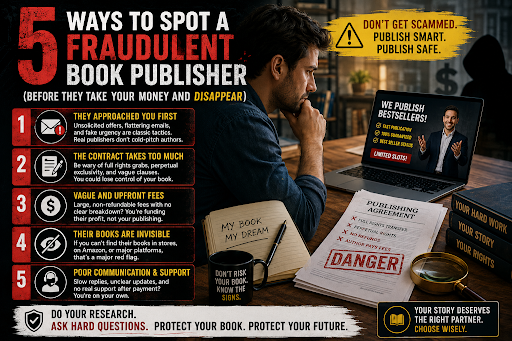
Legitimate publishers whether a full-service book publishing house or a professional hybrid publisher do not cold-email authors out of nowhere telling them their manuscript is exceptional. They don't DM you on Instagram. They don't find your self-published book on Amazon and tell you they want to "take it to the next level."
That's a sales funnel. Not a publishing opportunity.
The predatory publishing model works like this:
• They scrape author forums, writing groups, and self-publishing platforms
• They send mass outreach that feels personalized
• They create urgency ("We only have two slots left this quarter")
• They shower you with flattery before they've read a single page
Real publishers receive submissions. They don't chase authors.
If a company contacted you first with an unsolicited publishing offer, treat it as a scam until proven otherwise because statistically, it almost certainly is.
This is where fraudulent publishers do their most lasting damage and it's buried in language most authors don't read carefully.
Predatory contracts typically include:
• Full copyright transfer — they own your book, not you
• Perpetual exclusivity clauses — they control your book forever, even if they do nothing with it
• Reversion of rights buried in fine print — getting your rights back requires conditions that are nearly impossible to meet
• Overly broad subsidiary rights — they claim audio, translation, film, and merchandise rights they'll never exploit but will block you from pursuing
A legitimate book publishing agency will clearly explain every rights clause. They'll tell you exactly what they need to do their job and nothing more. Their contract protects both parties, not just themselves.
What to do: Before signing anything, run the contract past a publishing attorney or submit it to the Authors Guild contract review service. The $300 you spend on legal review could save you your entire career.
Money flow is one of the clearest indicators of legitimacy in publishing.
Here's the rule that never changes: predatory publishers make money from authors. Legitimate publishers make money from book sales.
Watch for these financial red flags:
| Warning Sign | What It Actually Means |
|---|---|
| Large upfront fee with no itemized breakdown | They're selling you a package, not a service |
| "Publishing fee" with no deliverable timeline | Your money disappears into a vague process |
| Non-refundable deposits before any work begins | No accountability for delivery |
| Upsells after you've already paid | The original package was never complete |
| Royalties paid quarterly with no sales reporting | You'll never verify what you actually earned |
A professional full-service book publishing company in the USA will provide a clear, itemized contract showing exactly what each fee covers, when deliverables are due, and what happens if they fail to meet those commitments.
If they can't tell you precisely what your money pays for, don't pay it.
This is the due diligence check most authors skip and it's one of the most revealing.
Every legitimate publisher has a portfolio. Books you can find. Books with real distribution. Books available on Amazon, in libraries, through Ingram, at brick-and-mortar retailers.
Here's how to verify a publisher's legitimacy:
• Search their catalog on Amazon — are the books actually there?
• Check the books' rankings — a publisher claiming major success should have books with some sales history
• Look up their ISBNs — search on WorldCat to see if their titles are in libraries
• Read the reviews — are reviews real, verified purchasers, or do they all sound like marketing copy pasted on the same day?
• Google "[Company Name] complaints" or "[Company Name] scam" authors talk
A credible self-publishing company will welcome this scrutiny. They'll hand you a portfolio before you ask. They won't conceal you with past authors directly.
If a publisher becomes defensive when you ask to see their published work, that defensiveness is your answer.
This one is subtle but devastating.
Fraudulent publishers sell certainty in an industry built on uncertainty. They promise:
• "We'll get you to Barnes & Noble" — distribution access ≠ shelf placement
• "Guaranteed bestseller status" — this either means nothing or refers to a manipulated paid category
• "Major media coverage included" — from outlets they won't name
• "We have connections with Hollywood" — used to justify premium packages, rarely delivered
• "Your book will be translated into 12 languages" — translation rights require separate deals entirely
A trustworthy self-publishing agency will tell you what's possible, what's probable, and what they can actually commit to in writing. They'll give you realistic projections, not fantasies.
The more extravagant the promise, the more carefully you should examine what's actually in the contract.
Use this before committing to any publisher:
• Did they approach me unsolicited? (Yellow flag)
• Can they provide an itemized fee breakdown?
• Do I retain full copyright after signing?
• Can I find their published books on major retail platforms?
• Are there verifiable author testimonials with real names?
• Have I searched their name on Writer Beware and the BBB?
• Has a publishing attorney reviewed the contract?
• Do their promises appear as written commitments in the contract?
• Is there a clear refund or cancellation policy?
• Do I have a direct point of contact, a named person, not a generic inbox?
If you're checking more than three boxes as concerns stop. Do not proceed until every box is resolved.
Here's what separates a predatory operation from a genuine partner:
Legitimate self-publishing services provide:
• Full transparency on pricing before any commitment
• Contracts that clearly protect authors' rights
• A verifiable portfolio of published titles
• Named staff and direct communication channels
• Realistic timelines with accountability
• Post-publication support not just a finished product and a goodbye
Companies like Hollywood Book Publishers operate on a fundamentally different model, one where the author's success is the metric that matters, not the size of the upfront check. Every author deserves a partner who has more to gain from their book succeeding than from signing them.
Fraudulent publishers believe because the publishing process is unfamiliar. The desire to be published, to see your book, to see your name on a cover that desire is real and valid. And predators exploit it with precision.
The best defense isn't cynicism. It's knowledge. Know what legitimate book publishing looks like. Know what your rights are. Know what questions to ask. And never let urgency manufacture or real push you into a decision you haven't fully examined.
Your manuscript took years. Your publisher decision deserves more than twenty minutes.
Start with Writer Beware (writerbeware.org) and the Better Business Bureau. Search the company name alongside words like "scam," "complaint," or "review" on Google. Look up their published titles on Amazon and WorldCat. Request references from actual authors they've worked with. Legitimate publishers will support every step of this process.
In hybrid and self-publishing models, yes, author investment is standard. What's not standard is vague pricing, non-refundable lump sums with no deliverable schedule, or fees that keep growing after you've signed. Any upfront cost should come with a detailed, itemized breakdown and a signed agreement specifying exactly what will be delivered and when.
A legitimate publisher's contract should include clear language that states who retains copyright, exactly what rights the publisher receives, and for how long. It should also explain the royalty structure, production timeline with milestones, and conditions under which rights revert to the author. If any of these elements are missing or vague, do not sign.
This depends on your contract, which is exactly why reading it before signing is non-negotiable. Some predatory contracts include clauses that give them ownership of submitted manuscripts. Never submit your manuscript to a publisher before reviewing the contract and confirming exactly what rights you retain throughout the process.
A vanity publisher charges authors to publish with little quality control or marketing support; it's a questionable model, but not necessarily illegal. A fraudulent publisher takes money and delivers nothing — or delivers substandard work with no recourse for the author. The key difference is whether what was promised in the contract is actually delivered. If it isn't, that crosses from predatory into potentially actionable fraud.
Recent Posts
Use the form below to contact us regarding your ghostwriting concerns. Please be as detailed as possible. You may also email or call us for more information.