



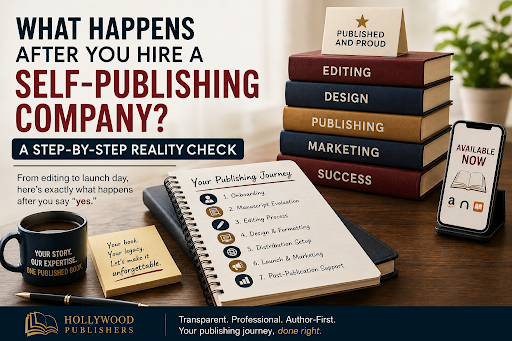
If you've already signed with a book publishing company or are seriously considering it, you're probably wondering the same thing most first-time authors wonder: "Okay, I handed over my manuscript, now what actually happens?" Nobody warns you about the waiting, the revisions, the back-and-forth emails, or the moment your proof copy arrives and something's just slightly off. This guide breaks down the entire post-hire journey with real talk, not brochure language.
The moment you hire a publisher, don't expect your book to magically appear on Amazon in 48 hours. The first phase is onboarding, and it matters more than most authors realize.
Here's what typically happens:
• You'll complete an author questionnaire covering your genre, target reader, comparable titles, and marketing goals
• Your manuscript gets assigned to a project coordinator
• You'll discuss your timeline and publishing goals (holiday release? milestone birthday gift? legacy project?)
• You'll sign off on scope of work, revision rounds, and deliverables
What authors in their 40s and 50s often don't expect: This phase requires your active participation. You're not handing off a car to a mechanic and walking away. Your experience, your voice, your vision — those still have to come through, and the team needs your input to protect them.
Hollywood Publishers tip: Keep a dedicated email folder for all communications. You'll reference these more than you think.
Before the first word gets edited, your manuscript goes through an evaluation. This is where a professional reader, usually a senior editor, assesses:
• Structural integrity (Does the book have a clear arc, logical flow, chapter organization?)
• Voice consistency (Does it sound like you throughout?)
• Market positioning (Where does it sit in the current book market?)
• Technical issues (Pacing, repetition, unresolved threads)
Many authors over 50 have poured years into their manuscript. Hearing that Chapter 3 needs to be restructured or that the ending feels rushed can sting. But this isn't a creative writing class critique, it's a professional analysis designed to protect your book's commercial viability.
The evaluation usually takes one to two weeks and ends with a written editorial report. Read it carefully. Ask questions. Push back where your instincts tell you to; you know your story better than anyone.
This is the longest phase, and it typically unfolds in layers:
Big-picture fixes. Chapter restructuring, plot holes (even in memoirs and non-fiction), character consistency, narrative arc. This is the "surgery" stage.
Sentence-level refinement. Your editor works on clarity, rhythm, word choice, and readability. A strong line edit is what separates a self-published book that reads professionally from one that reads like a draft.
Grammar, syntax, spelling, punctuation and the mechanical stuff. This round catches what spell-check never will.
Final pass. Often done by a second set of eyes. This is your last chance to catch errors before the book goes to layout.
Total editorial timeline: Anywhere from 6 to 16 weeks depending on your manuscript length and the number of revision rounds in your package.
Once edits are approved, your book moves into production. This includes two parallel tracks:
Your cover designer will typically ask for:
• Genre preferences and comparable book covers
• Color palette ideas (or complete creative freedom)
• Author photo and bio for the back cover
• Any specific imagery or symbols meaningful to the story
You'll receive two to four cover concepts. Pick one, request revisions, and approve the final version. Don't rush this step. Your cover is your book's primary marketing tool, especially on Amazon, where readers scroll fast.
This is where your manuscript transforms from a Word document into a formatted book. Your typesetter handles:
• Font selection and hierarchy
• Chapter header design
• Page numbering and margins
• Widows, orphans, and line breaks
• Front matter (dedication, copyright, table of contents)
• Back matter (author bio, acknowledgments, index if applicable)
You'll receive a PDF proof. Read every single page. Authors frequently miss errors at this stage because they're reading for content, not layout. Read it differently, slower, out of order if needed.
This is the administrative backbone of your publishing journey. Here's what gets handled:
• ISBN assignment — Your book's unique identifier, required for retail distribution
• Copyright registration — Protects your intellectual property (Hollywood Publishers can guide you through Library of Congress registration)
• BISAC category codes — The classification codes that help retailers and libraries shelve your book correctly
• Distribution channel setup — Amazon KDP , IngramSpark, Barnes & Noble Press, and others depending on your package
Most self-publishing services today operate on a print-on-demand (POD) model. Your book doesn't get printed until someone orders it. This eliminates warehousing costs but means your per-unit cost is higher than offset printing.
If you're planning a large launch event or want to sell bulk copies, discuss a print run with your publisher early. Some authors over 50 planning legacy gifts for family find a small print run of 100–500 copies makes more sense for their goals.
Here's a hard truth: publishing your book and launching your book are two completely different events. The most successful self-published authors treat the launch like a campaign, not a date on a calendar.
What a solid launch strategy includes:
• Advance Reader Copies (ARCs) — Sent to reviewers, bloggers, and influencers 4–8 weeks before release
• Amazon Author Central profile — Fully optimized with your photo, bio, and linked titles
• Amazon category optimization — Strategic category selection can put you in "bestseller" territory in a niche
• Book launch email sequence — If you have an email list, even a small one, this is your most valuable asset
• Social proof gathering — Early reviews on Amazon and Goodreads dramatically affect discoverability
Most book publishing agencies offer marketing add-ons. If yours does, this is worth the investment.
Your book is live. Congratulations genuinely. But this isn't where the work ends.
What comes next:
• Monitor your Amazon rank and reviews weekly for the first 60 days
• Respond to reader emails and reviews (professionally and warmly)
• Pitch your book to local bookstores, libraries, and community organizations
• Explore speaking opportunities: libraries, civic groups, and senior centers are particularly receptive to local authors
• Track your royalty statements monthly
Not all publishing companies operate with equal integrity. Watch for:
• Excessive upselling after signing — constant pressure to buy add-ons you didn't discuss upfront
• No transparent royalty reporting — you should always know what you've earned and when
• Missed deadlines with no communication — delays happen, but silence is unacceptable
• Edits that erase your voice — a good editor shapes your voice, not replaces it
Most self-publishing timelines run 4 to 9 months for a properly produced book. Anyone promising 30-day turnarounds is likely cutting corners on editing or design.
With legitimate self-publishing services, yes, always. You own your copyright. If a company asks you to sign away ownership, walk away.
Vanity publishers charge high fees and offer minimal editorial quality or distribution support. Professional self-publishing companies like Hollywood Publishers provide real editorial services, legitimate distribution, and transparent royalty structures.
Yes. With POD distribution, you can upload revised interior files or a new cover. However, changes to printed copies already in circulation aren't possible, and ISBN rules apply if changes are substantial.
Your royalty rate depends on your distribution channels and retail pricing. Most authors earn 40–70% of net receipts through POD platforms. Your publishing company should provide a clear royalty schedule before you sign anything.
Hollywood Publishers works with first-time and experienced authors across the United States, providing transparent, author-first publishing support from manuscript to market.
Recent Posts
Use the form below to contact us regarding your ghostwriting concerns. Please be as detailed as possible. You may also email or call us for more information.