



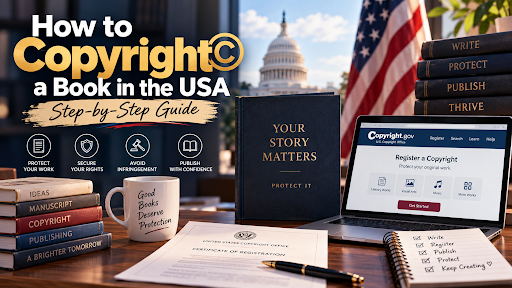
You spent months, maybe years writing your book. The last thing you want is someone stealing it, republishing it, or profiting from your words without your permission.
Here's what most authors don't know: automatic protection and registered protection are two completely different things, and only one of them lets you take someone to federal court and win real money.
Whether you're working with a professional book publishing company or going it alone, understanding how to protect your work legally isn't optional. It's essential. And the process is simpler and cheaper than most people expect.
The moment you write original text and save it in any fixed form, copyright protection automatically exists. No filing, no fee, no symbol required. Your manuscript sitting in a Google Doc right now is technically protected.
So why does registration matter?
| Protection Type | What You Get |
|---|---|
| Automatic Copyright | Ownership — limited legal enforcement |
| Registered Copyright | Federal court access + statutory damages up to $150,000 + attorney's fees |
If someone steals your unregistered book, you can prove you wrote it, but you can't claim statutory damages or access federal court. In practical terms, an unregistered copyright is extremely difficult and expensive to enforce.
Think of it this way: automatic copyright is the lock on your door. Registration is the alarm system, the security camera, and the contract with a security company all at once. Registration is how you give your copyright real teeth.
You may have heard: "Mail a copy of your manuscript to yourself and keep the envelope sealed. The postmark proves you wrote it."
This is completely wrong and dangerously misleading. Here's why it fails every time:
• It has no provision in U.S. copyright law — the Copyright Office explicitly says so
• It doesn't qualify you for federal court — without registration, you can't file a federal infringement lawsuit
• Envelopes can be manipulated — pre-mailed envelopes can be filled and resealed; courts and defense attorneys know this
• In the digital age, infringement happens in minutes — your postmarked envelope arriving days later proves nothing
The U.S. Copyright Office itself has publicly debunked this myth multiple times. Do not rely on it. Register properly.
Register the final version of your work, not a draft. The Copyright Office requires the "best edition" available. If you later substantially revise the book, you may need a new registration for the updated version.
Have ready:
• Final manuscript in PDF format
• Author legal name and contact information
• Title and publication status (published or unpublished)
• Year of creation
The U.S. Copyright Office's online system is called the eCO System (Electronic Copyright Office), the fastest and cheapest route. Paper applications cost more and take significantly longer, sometimes over a year.
• Go to copyright.gov
• Click "Register a Copyright"
• Select "Literary Works"
• Create an account; it persists indefinitely for all future titles
This is where many authors make costly mistakes; choosing the wrong application type means paying more than necessary or filing incorrectly:
| Application Type | Cost | Best For |
|---|---|---|
| Single Application | $45 | One author, one work, full ownership |
| Standard Application | $65 | Multiple authors or complex ownership |
| Group of Unpublished Works | $85 | Multiple unpublished works together |
| Paper Filing | $125 | Not recommended — much slower |
For most solo authors, the Single Application at $45 is the correct choice. The book publishing services team at Hollywood Book Publishers can confirm which application type fits your specific publishing situation before you file.
Inside the eCO dashboard, select "Register a New Claim," then choose:
• Work type: Literary Work
• Material type: Text
The Copyright Office requires precise information. Make sure you complete these sections carefully:
• Title and year of creation
• Publication status — published or unpublished
• Author and claimant information
• Rights and permissions contact — who handles licensing requests
Small errors like a misspelled name, an incorrect publication date, or mismatched ownership details can trigger review delays and back-and-forth communication with Copyright Office examiners. Take your time on this step. It’s worth doing right the first time.
After completing the form, pay by credit card, debit card, or electronic check. Save your payment confirmation and case number for tracking.
Then upload your manuscript deposit copy — the official reference version that becomes part of the Copyright Office’s permanent records:
• Unpublished works: One complete PDF copy of the manuscript
• Published works: Requirements vary; physical copies may be required depending on edition type
The deposit copy must match the version you’re registering exactly. Do not upload a draft if you’re registering the final published edition.
| Filing Method | Processing Time |
|---|---|
| Online (eCO) | 3 – 8 months |
| Paper filing | 12+ months |
Your effective registration date is the day the Copyright Office receives your complete application, not when the certificate arrives months later. This is critical. If someone infringes your work while your application is being processed, your legal protection still dates back to your original filing day.
When processing completes, you’ll receive an official Certificate of Registration — your permanent legal proof of copyright ownership.
Every professionally published book needs a copyright page, typically the back of the title page. This is separate from registration but signals active ownership to every reader, retailer, and potential infringer who opens your book.
A professional book publishing agency formats this correctly as a standard part of the publishing process.
It should include:
• © [Year] [Author Name]. All rights reserved.
• A statement prohibiting reproduction without permission
• Publisher name and location
• ISBN for each format (print, eBook, hardcover)
• Library of Congress Control Number
• Edition and printing information
Missing or incorrectly formatted copyright pages are one of the most common signs of an amateur publication and one of the easiest things to get right with professional support.
Register before publication or within 3 months of it. Here’s exactly why timing matters:
• Register before infringement → eligible for statutory damages up to $150,000 per willful infringement + attorney’s fees
• Register within 3 months of first publication → may still qualify for full statutory damages even if infringement occurs after publication
• Register after infringement AND after the 3-month window → only actual damages, which in most cases are difficult to prove and often near zero
The window is narrow, and the financial difference is enormous. A professional book publisher in the USA, like Hollywood Book Publishers, builds copyright registration into the pre-publication checklist so this critical step never gets missed or mistimed.
Most articles skip this entirely. These are the errors that cause real legal and financial damage:
• Registering too late — after infringement has occurred, losing the right to statutory damages
• Registering a draft — the registered version must exactly match what was published
• Skipping the copyright page — signals no active protection and looks unprofessional
• Not registering revised editions — substantial revisions need their own separate registration
• Relying on “poor man’s copyright” — no legal standing, no federal court access, period
Yes — but automatic and registered copyright are functionally different. Without registration, you cannot sue in federal court or claim statutory damages up to $150,000 per infringement. Registration is what gives your copyright real, enforceable legal power.
As of 2026, $45 for a Single Application and $65 for a Standard Application. Paper filing costs $125 and takes significantly longer. For most solo authors registering a book they wrote and own entirely, $45 is the correct fee.
Online registration through the eCO system typically takes three to eight months for processing. Your effective date is the day the Copyright Office receives your application, so legal protection begins the day you file, not when the certificate arrives.
If a new edition contains substantial new content or major revisions, register it separately as a new work. Minor corrections like typo fixes generally don’t require a new registration. When unsure, consult your publishing team before filing.
Yes. Hollywood Book Publishers offers comprehensive publishing support including copyright page formatting, Library of Congress registration, and ISBN assignment across all formats. As a full-service book publishing agency, every step is handled in the right order so nothing gets missed, mistimed, or filed incorrectly.
Your words took years to write. Protecting them properly costs $45 and a few hours of your time. There’s no reason not to.
Recent Posts
Use the form below to contact us regarding your ghostwriting concerns. Please be as detailed as possible. You may also email or call us for more information.