



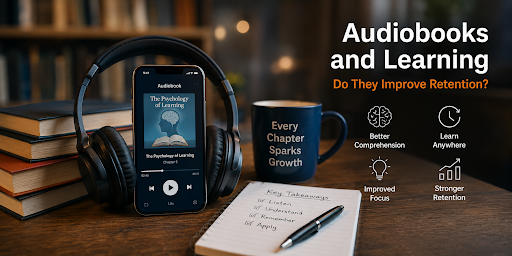
A decade ago, audiobooks were a road-trip thing, a way to get through a book without really "reading" it. That perception hasn't aged well. Audible reported in its 2023 listener data that nonfiction and educational titles made up a significant share of its fastest-growing categories, which says something about how people are actually using the format now and why more authors are turning to a dedicated audiobook services agency to produce something listeners will actually finish, rather than treating narration as an afterthought.
There's a persistent idea that listening to a book is a watered-down version of reading it. Dual-coding theory, first proposed by psychologist Allan Paivio in the 1970s, suggests otherwise: verbal and auditory information get processed through related but distinct cognitive channels, and audio can activate comprehension just as effectively as text, sometimes more so, when narration supplies tone and pacing that flat print can't.
A 2019 study out of the University of Virginia, led by psychologist Daniel Willingham, compared comprehension scores between readers and listeners working through the same material. The scores came out nearly identical. The one consistent difference: listeners picked up emotional nuance more reliably, because narration does interpretive work a silent reader has to do alone.
Reading text requires the brain to decode symbols into words and build meaning from them simultaneously. For some learners, particularly those with dyslexia, decoding eats up enough working memory that comprehension takes the hit. Strip out the decoding step entirely, and there's more mental room left for actually understanding the material.
The same line read flat versus read with the right inflection can carry sarcasm, grief, or urgency that print simply can't deliver on its own. Becoming, narrated by Michelle Obama herself, is one of the more cited examples of this. Reviewers consistently note the audio version lands differently than the print edition, not because the words changed, but because the delivery did.
A commute, a gym session, a load of laundry, none of that used to carry any learning content at all. Now it can. This isn't really about multitasking efficiency; it's about exposure time that wouldn't exist otherwise. Repetition and familiarity, even picked up passively, are well-documented drivers of long-term retention.
Most professional narration sits around 150–160 words per minute, close to natural conversational speech. That consistency gives the brain a rhythm to latch onto, which several memory researchers tie to improved recall, particularly for sequential or narrative material like biographies and history.
Estimates vary, but a meaningful share of people often cited around 30% process spoken information more effectively than written information. For this group, audiobooks aren't a workaround. They're often just the better format from the start.
Pairing audio with on-screen text, sometimes called bimodal reading, shows up frequently in language-learning research. Hearing correct pronunciation and intonation while seeing the word reinforces recognition faster than either channel alone, which is part of why apps like LingQ build their entire model around this pairing.
| Factor | Reading | Listening (Audiobook) |
|---|---|---|
| Cognitive load | Higher decoding plus comprehension | Lower comprehension only |
| Fact retention | Strong | Comparable |
| Emotional nuance | Depends on the reader | Often stronger, narrator-driven |
| Fits into multitasking | Limited | High |
| Works best for | Dense technical or reference text | Narrative, conversational content |
A few things worth being honest about:
• Narrative nonfiction, biographies, and business books built on case studies translate well to audio.
• Dense reference material, anything you'll need to flip back through, usually works better in print or e-book form.
• Language learning benefits most from combining both formats at once, not choosing one over the other.
• Speeding playback past around 1.25x tends to cost comprehension on new or complex material, according to research out of UCLA's memory lab; it's not the free efficiency gain it feels like.
Everything above depends on the audiobook actually being produced well. A flat, rushed narration undoes most of the retention benefits. Research points to pacing and tone aren't cosmetic choices, they're functionally part of how well a listener absorbs the material.
This is exactly where working with experienced audiobook publishing services makes a measurable difference. Narrator selection, pacing, and post-production aren't things most authors can judge well on their own, especially with nonfiction or educational content where comprehension carries as much weight as enjoyment.
A few questions worth asking any audiobook publishing company before signing on:
The publishing world has never offered more options. The key is knowing which ones actually serve your goals and partnering with a book publisher who treats your manuscript with the same care you put into writing it.
1. Do they match the narrator's tone to the genre, rather than using a one-size-fits-all voice roster?
2. What does their quality control process look like for pacing and pronunciation?
3. Do they handle distribution to Audible, Spotify, and Apple Books, or only production?
4. Will they provide a sample chapter before the full book is committed to?
5. Have they worked in your specific genre before?
A partner worth hiring treats narrator casting as a comprehension decision, not just a creative one.
Audiobooks aren't a workaround for reading, and they're not a diminished version of it either. For a large share of listeners, they're simply the more effective way to absorb narrative and conversational material, and increasingly, how well that audiobook was produced in the first place is what determines whether any of these retention benefits actually show up.
Reach Out to Us for Further Assistance.
For narrative material, retention scores tend to land close to even. Willingham's 2019 study is a frequently cited reference point here.
Less so. Text generally works better when you need to pause, flip back, or reread sections.
Yes, going past roughly 1.25x speed tends to reduce comprehension, particularly with unfamiliar material.
Substantially, especially when paired with the written text at the same time, rather than used alone.
Pacing, tone, and delivery directly shape comprehension, which is why production choices affect retention just as much as the content itself.
Recent Posts
Use the form below to contact us regarding your ghostwriting concerns. Please be as detailed as possible. You may also email or call us for more information.