



If you've ever finished writing a manuscript and thought, "Now what?" you're not alone. Most authors pour everything into writing their book, only to hit a wall when it comes to getting it published. That's exactly where book publishing support comes in.
Whether you're a first-time author or someone who's been through the process before, understanding what publishing services actually cover can save you time, money, and a whole lot of frustration.
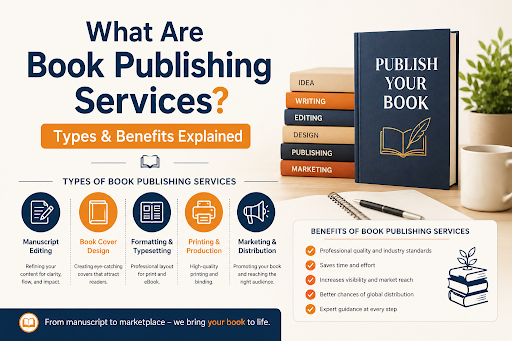
Book publishing solutions refer to the professional support system that takes a manuscript from raw draft to a finished, market-ready book. This includes everything from editing and cover design to printing, distribution, and marketing.
Think of it this way: writing the book is your job. Everything that happens after—the formatting, the ISBN registration, and the distribution to retailers—is what a professional publishing service handles.
These offerings can be provided by a traditional publishing house, an independent book publishing company, or a specialized agency, depending on your goals and budget.
Here's the honest truth: You can self-publish without any help. But authors who consistently produce professional, commercially successful books almost always have a team behind them.
Here's why professional support matters:
• First impressions are everything — A poorly formatted book or weak cover kills sales before a reader opens the first page
• Distribution is complex — Getting into Amazon, Barnes & Noble, and international retailers requires industry knowledge
• Editing is non-negotiable — Even the best writers need an objective editorial eye
• Marketing requires strategy — Knowing when and how to promote your book is a skill most authors build over time
• Time is valuable — Outsourcing production lets you focus on what you do best: writing
A publisher offers you a contract and handles everything: editing, design, printing, and distribution in exchange for royalties.
Best for: Authors with literary agents or manuscripts in high-demand genres.
Downside: Highly competitive, and you give up creative control.
Platforms like Amazon KDP and IngramSpark let authors publish independently. Doing it well still requires professional editing, cover design, and formatting support.
Best for: Authors who want full creative control and higher royalty percentages.
Downside: Every cost and decision falls on you.
Hybrid publishing sits between traditional and self-publishing. You work with a professional book publishing agency that provides editorial, design, and distribution, but you retain your rights.
Best for: Authors who want professional quality without giving up ownership.
Downside: Upfront investment required for researching providers thoroughly.
Dedicated ebook solutions cover formatting, metadata optimization, platform distribution across Kindle, Apple Books, and Kobo, and pricing strategy.
Best for: Authors targeting digital-first audiences or testing the market before a print run.
Books are printed individually as orders come in, eliminating large upfront print runs and storage costs.
Best for: Independent authors, niche titles, and special edition releases.
From developmental editing to proofreading, professional editorial support is the single most important investment any author can make, regardless of publishing path.
Launch strategy, social media campaigns, ARC distribution, and Amazon optimization fall under this category. A coordinated launch strategy maximizes early momentum and long-term visibility.
| Benefit | What It Means for You |
|---|---|
| Professional quality | Your book competes with traditionally published titles |
| Faster time to market | Structured workflows reduce production delays |
| Wider distribution | Access to global retail networks and libraries |
| Rights protection | Clear contracts protect your intellectual property |
| Marketing support | Targeted campaigns reach your ideal readers |
| Ongoing royalties | A correct setup ensures you get paid accurately |
Not every service is right for every author. Here's a quick checklist before you commit:
• Define your goal — profit, legacy, or professional credibility?
• Set a realistic budget — quality publishing support is an investment, not an expense
• Check their portfolio — has the company published books in your genre?
• Read the contract carefully — who owns the rights and what are the royalty terms?
• Ask about distribution — where will your book be available after publication?
• Look for transparency — a trustworthy book publishing company never hides fees or overpromises results
The publishing industry has its share of predatory operators. Watch out for:
• Guaranteed bestseller promises no legitimate publisher can promise this
• Vague contracts with hidden fees
• No editorial process, skipping editing, is a serious red flag
• Pressure to buy large packages upfront without seeing sample work
• No verifiable client testimonials or published titles in their portfolio
Understanding book publishing is essential for any author serious about reaching the right readers. Whether you're drawn to traditional publishing, exploring hybrid options, or going fully independent, professional support makes the difference between a book that gets noticed and one that gets lost.
The publishing world has never offered more options. The key is knowing which ones actually serve your goals and partnering with a book publisher who treats your manuscript with the same care you put into writing it.
Reach Out to Us for Further Assistance.
They typically include editing, cover design, formatting, ISBN registration, printing or ebook conversion, distribution, and marketing support, depending on the provider.
Costs vary widely. Basic support starts from a few hundred dollars, while full-service hybrid publishing packages range from $2,000 to $10,000 or more.
An agency provides hands-on, personalized support across the full publishing journey. A self-publishing platform is a tool you use independently; editorial and design work is entirely up to you.
It depends on the model. Traditional publishers typically acquire rights. Hybrid and self-publishing services generally allow you to retain full ownership.
Traditional publishing can take 1–2 years from contract to shelf. Hybrid and self-publishing routes typically move faster, often 3 to 6 months with professional support.
Recent Posts
Use the form below to contact us regarding your ghostwriting concerns. Please be as detailed as possible. You may also email or call us for more information.